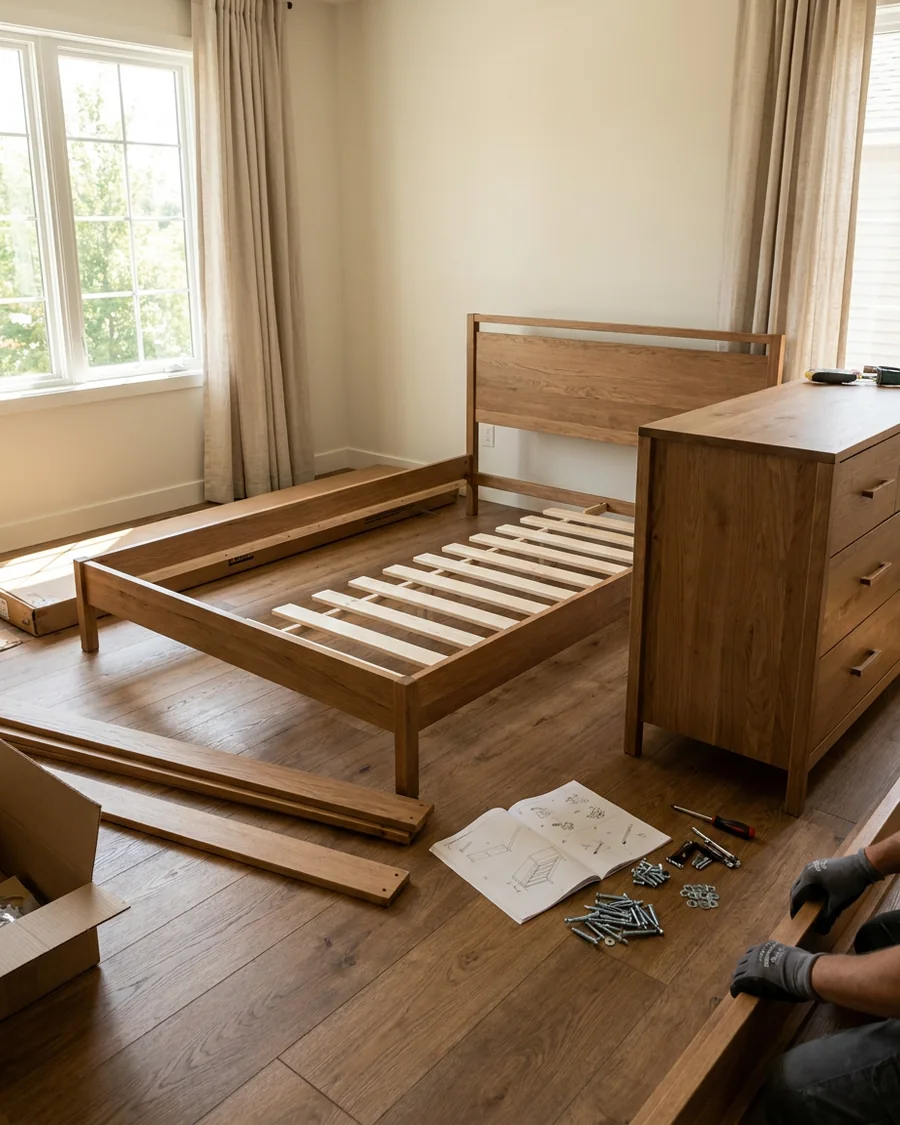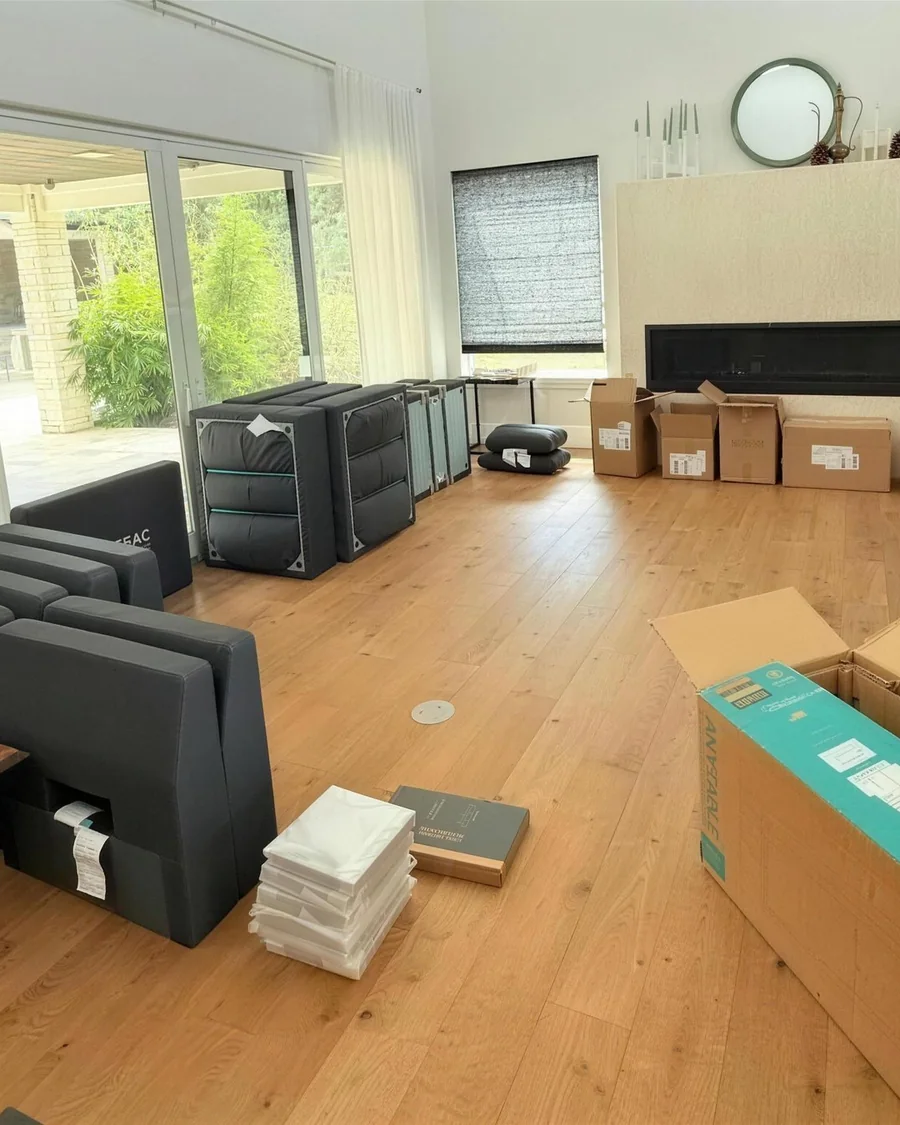
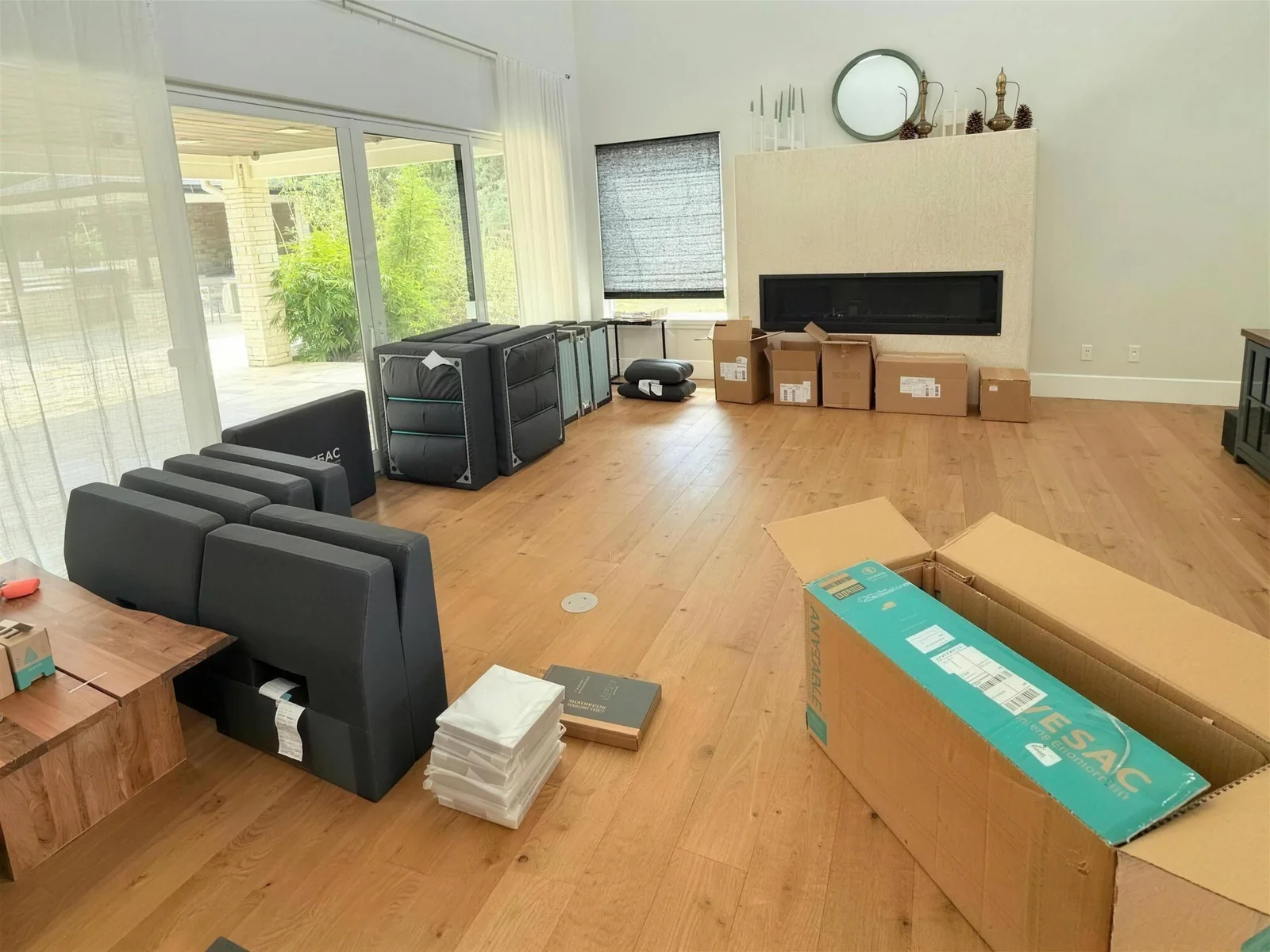
What is worth doing before a furniture assembler arrives?
The hardware that came in the box, the cartons in the room each piece is going to, and a clear floor around them. Only the hardware is strictly required, because we bring every professional tool the job needs.
Everything else is a decision rather than a task. A furniture assembly visit runs to plan when those decisions are made before the crew arrives, not in front of it, and most jobs come down to the same short list.
- The hardware bags, each kept with the carton it came in.
- The cartons in the room where each piece will live, or a note of where they are if they are still in the garage.
- Enough clear floor beside the cartons to lay the panels out.
- A decision on where each piece goes, to the floor plan if you have one.
- A way in if nobody will be home: a code, a lockbox or a callbox number.
- A place for the packaging, such as the garage, a closet or beside the bins.
None of it needs a tool. A decision made before we arrive is one nobody has to stop work for.
Do you need to be home for furniture assembly?
No, as long as we have access. A code, a lockbox or a callbox number given at booking is enough for the crew to get in, build every piece and place it.
We prefer someone is home, and placement is the reason. A dresser can go on either wall, a bed can face two ways, and a desk depends on where the window and the outlets are. If you will be out, settle those in advance: a sketch, a few notes or a photo of the room with each piece marked is enough.
Stepping out partway through is fine. If you can be back for one part of the visit, make it the walkthrough at the end.
Does a furniture assembler bring their own tools?
Yes. Masterwork Assembly brings all the professional tools the job needs, and the one thing that has to be there is the hardware that shipped with the item: the bolts, screws and fixings from the box.
That hardware is matched to the piece. A bolt from the wrong bag might thread, but it was not made for that joint, and the manufacturer's order depends on the right part going in at the right step.
So keep each hardware bag with its own carton. If a bag came loose when a box was opened, tape it back to that carton rather than collecting every bag in one drawer. Keep the manuals and the order details as well, because they make a replacement request quicker if anything is short.
Where should the cartons be when the assembler arrives?
In the room where each piece is going to live, with the floor around them clear. A piece built where it will stand never has to be carried through a door or around a landing once it is finished.
If the carrier left everything in the garage or just inside the front door, that is common. Tell us at booking where the cartons are and where each one is going, and mention stairs, a narrow hallway or a tight turn, so the crew plans the carry.
Until the day, store the cartons flat rather than leaning against a wall, and keep every numbered carton of a set together. A long panel left leaning can bow, and a set split between the garage and a bedroom is a set somebody has to go looking for.
What should you tell the assembler when you book?
What is arriving, roughly how many items, where they are going and how we get in. The item count decides how many people the job needs, and the access decides how the visit starts.
The booking form asks for a name, the address, a phone number, the items and when you need them, and that is enough to start. Add a line on stairs or a tight landing, anything that arrived damaged, and whether the cartons are already in their rooms.
If a tall dresser, a bookcase or a bunk bed should be anchored to the wall, say so at booking. Anchoring is offered and arranged in advance, because they need a technician qualified for the work; raised for the first time on the day, they cannot be added.
Same-day and next-day slots are genuine, depending on what is already on the board, so the earlier you call or text (512) 333-8525, the more of the day there is.
What if a part is short or damaged when the cartons are opened?
We tell you immediately, before anything is built. Every part is counted against the parts list before anything is joined, so a shortage is found at the start of the job, not halfway up a bunk bed.
Any pre-existing damage or missing part goes into a written inspection report. That puts the problem in writing, which is what a replacement request to the retailer or the manufacturer needs, and we help you identify the exact part and guide you on getting the replacement.
The piece that is short is not built without its part, and the rest of the job carries on around it. We do not repair damaged furniture or cut a substitute, because repairs and custom cutting are outside the service.
What happens to the boxes and packaging after assembly?
The boxes are broken down and the packaging is stacked wherever you want it, as standard on every job. Full haul-away is a paid add-on, so if you would rather none of it stays, ask for it when you book.
A room of furniture leaves more behind than people expect: flat cartons, foam corners, film and paper. The garage, a closet or the side of the house by the bins all work as a place for it. An apartment with no garage is usually where haul-away makes sense.
If a piece might go back to the store, keep its carton apart from the stack. Returns and replacement claims generally want the original packaging, one of the points covered in what to check before you sign for a delivery.
Can an assembler take furniture apart and rebuild it in another room?
Yes, inside the same home. A bed, a wardrobe or a desk that will not fit through a doorway in one piece is taken apart, carried to its new room and built again in the manufacturer's order.
Moving a piece from one room to another inside your home is included in the visit. Every part is counted before it goes back together, and any hardware that went missing is raised before the rebuild, not after it.
The same goes for furniture the movers took apart. Beds, dining tables, desks and modular seating are reassembled, leveled and placed where you want them, like any other build. Tell us at booking which pieces are changing rooms, so they are planned in with the rest.
What happens before the assembler leaves?
A walkthrough. Every drawer and door is opened in front of you and each piece is checked where it stands, before anything is packed up.
By then every piece has been built in the manufacturer's order, leveled with the feet set to the floor rather than the piece, and placed where you want it, not where the cartons landed. The work area is cleaned, and the packaging is wherever you asked for it.
We do not leave until you are happy with the assembly. What stands behind the work, from the breakage guarantee to the workmanship warranty, is set out in the Masterwork Promise, and every step of a visit is laid out in our process.
Common questions
Should I unpack the furniture before the assembler arrives?
No, leave that to the crew. Every carton is opened on site and each piece is checked for damage as it comes out of the box, with every part counted against the list and anything pre-existing written into the inspection report. If you have already opened a carton, to look for damage after delivery for example, put the panels and the hardware bag back with it. A carton's parts kept together are counted in one pass; parts spread across a room are not.
Does it matter where I bought the furniture?
No. Masterwork Assembly builds furniture from any brand and any retailer, flat-pack to designer, in the manufacturer's order. What helps is a list of the items and the manuals, which usually travel in a carton with the hardware. If the store sold you its own assembly or white glove option, read what it actually includes before delivery day, because the phrase on the checkout page and the work that arrives at your door are not always the same thing.
What if I change my mind about where a piece should go?
Say so before we leave and it is moved. Pieces are placed where you want them, not where the cartons landed, and the walkthrough is the moment to look at the room as a whole: a dresser moved to the other wall, a desk turned toward the window, a sectional rearranged. Deciding the layout before we arrive still helps, because modular seating arrives as separate seats, arms and backs, and its hardware is set to match the arrangement.
Is there anything a furniture assembler will not do?
Yes. Masterwork Assembly does no repairs, no cutting, altering or custom building of furniture or materials, and nothing electrical, so new outlets and wiring stay with your electrician. A damaged piece goes into the written inspection report and becomes a replacement request rather than a repair. Nearly anything that arrives flat or in parts, from a single bed frame to a whole move-in, is the job.