Why you inspect before you sign, not after
You inspect a furniture delivery before you sign because a clean signature on the delivery receipt is normally the moment the carrier's responsibility for visible damage ends. Everything worth checking gets checked at the door, with the driver still standing there and the pen still in your hand.
The document your signature goes on is the delivery receipt, sometimes printed as a bill of lading and sometimes handed over as a proof of delivery. The name on the form changes with the carrier. What it does does not: it records what arrived and what condition it arrived in.
After a clean signature the argument changes shape. You are no longer reporting damage that arrived, you are proving damage did not happen after the truck left. Carriers do accept claims found later, but the window is short and the carrier sets it, not you. Your own number is in the terms printed on the receipt and on the retailer's damage policy page, so read both before delivery day rather than after.
None of this takes long. Two or three minutes covers the whole of it, and it is the only part of the transaction that is genuinely yours to control.
Count the cartons against the manifest
Counting the cartons against the manifest means checking the number of boxes that came off the truck against the piece count printed on the driver's paperwork, and it is the first thing to do, before you look at anything else. If the manifest says six and five come off the truck, that is a shortage, and it belongs in writing at the door rather than as a discovery on build day.
Count what is physically in front of you, not what the driver tells you is in front of you. Cartons get stacked, doubled up and hidden behind each other on a liftgate, and two boxes taped together still count as two.
A shortage is the easiest problem on this list to fix and the easiest one to miss, because a delivery that looks like a lot of boxes looks the same whether it is complete or not.
One piece of furniture often arrives as several boxes
One piece of furniture often arrives as several boxes, labelled 1 of 3, 2 of 3 and so on, and the piece is not complete until every numbered carton in that set is in the room. A set can be split across trucks or across days without anybody telling you.
Sectionals, beds, dining tables with separate leaves, wardrobes and anything carrying glass or stone are the usual ones. Read the labels rather than the shapes. Two boxes that look identical can be halves of different products, and the one that matters is the one nobody notices is missing.
Hardware usually travels in one carton of the set, sometimes taped inside the largest box. If a set arrives incomplete, assume the fixings may be in the box that did not turn up, and say so when you report the shortage.
What concealed damage means, and why the outside of the box matters
Concealed damage is damage found after the carton is opened, when the outside of the box gave no obvious sign of it, which is why the outside of the box is the only evidence you have at the door and why it is worth a proper look before you sign.
You usually cannot open a sealed carton with a driver waiting. Five things on the outside are worth a few seconds each.
- Crushed corners. Furniture is braced at the corners, so a drop shows there first. A crushed corner is the most common place to find a chipped edge or a split panel underneath.
- Punctures and tears. A forklift tine or a tightened strap can go through cardboard and into the finish behind it. Anything that broke the box has a fair chance of having reached the piece.
- Water staining and swelling. A tide line, or a patch that feels soft and wavy, means the carton stood in water at some point. Particle board and veneer swell, and they do not come back.
- A carton that rattles or shifts. Something inside has moved. That is either loose fixings or a part no longer attached to what it was attached to.
- Tape that is not the manufacturer's. A retaped or re-strapped box has been opened somewhere between the factory and your door, and whatever happened while it was open is not recorded anywhere.
Any of those is worth noting on the receipt even if the piece turns out to be perfect. A note that proves unnecessary costs you nothing. The absence of one can cost you the claim.
How to write an exception on the delivery receipt
An exception is a note you write on the delivery receipt itself, before you sign, describing exactly what is short or damaged, and it has to appear on the copy the driver takes away as well as on yours. A verbal assurance at the door has no weight later, however genuinely it was meant.
Be specific. The word damaged on its own is weak. Carton 2 of 4, crushed corner, puncture on the long side is a description somebody else can match to a photograph months afterwards.
Handle a shortage the same way: write the count received against the count on the manifest. If the paperwork is a handheld screen rather than paper, the same rule applies. There is a notes field, ask for it, and photograph the screen once you have typed into it.
Refusing a carton outright is an option, and occasionally the right one for something obviously destroyed. It is also the slowest route, because a replacement normally starts the clock again from the beginning. Accepting with a written exception keeps the piece in the house while the claim runs.
Photograph the cartons where they sit
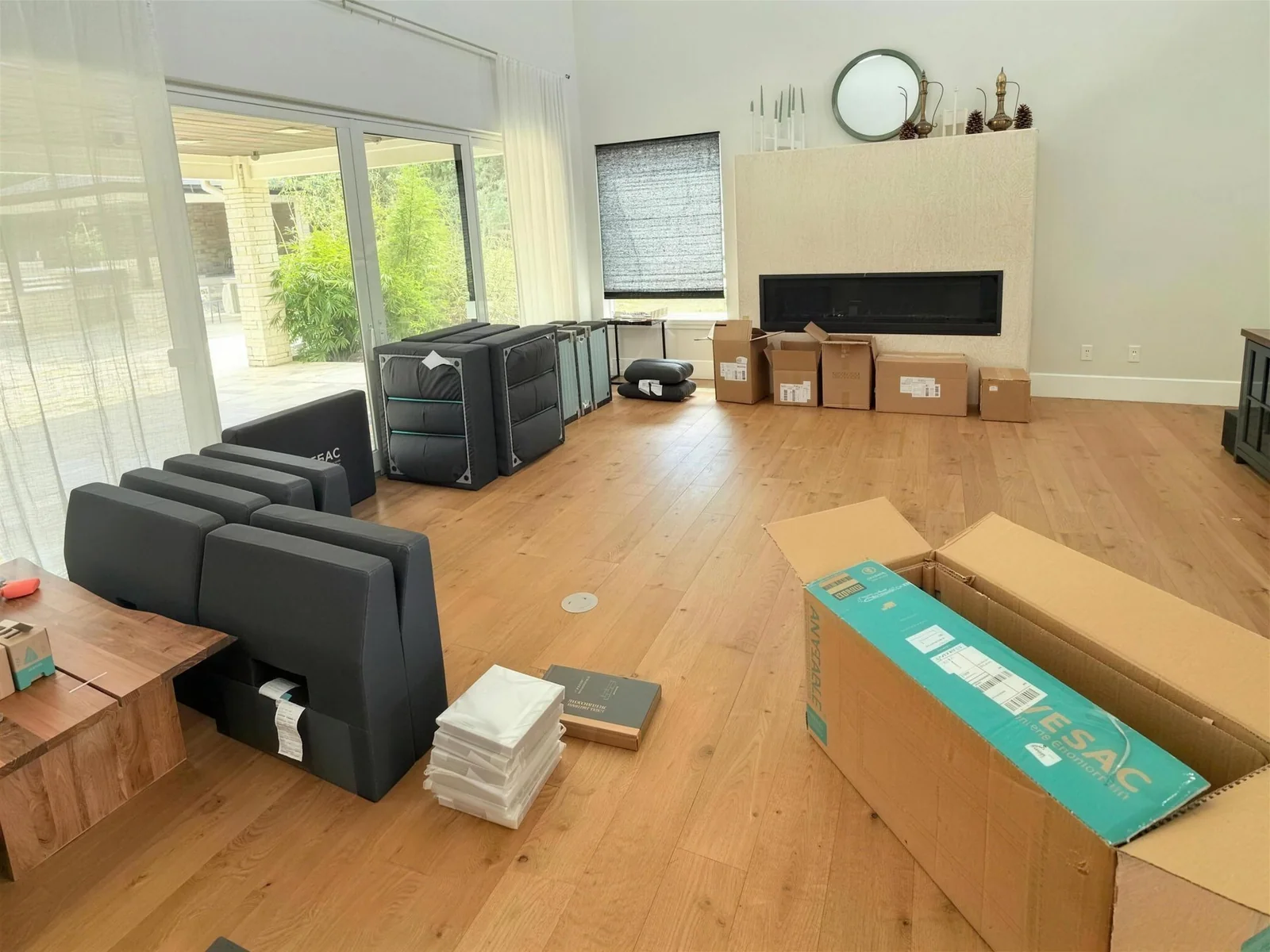
Photograph every carton where the driver sets it down, before he leaves, with the shipping label readable in at least one frame. Pictures taken at the door with the boxes still sealed are what separate damage that arrived from damage that happened in your hallway.
Take one wide shot of the delivery as a group, then a close shot of each label and each defect. The label is what ties a photograph to a specific carton in a specific shipment. Without it you have a picture of a box, which proves nothing.
Keep the photographs until the build is finished and the piece has been checked over, and keep the cartons until the return window on your order closes. Returns and replacement claims generally want the original packaging, and a flattened box in the garage is much easier to produce than a new one. The exact length of that window is on the retailer's returns page, not on the carton.
Threshold, room of choice and white glove
Threshold, room of choice and white glove are the three standard delivery levels, and they decide how far into the house the carrier goes: threshold stops just inside the entrance, room of choice puts sealed cartons in the room you name, and white glove unpacks and places the piece.
- Threshold. The shipment goes to the first dry, covered spot inside the entrance, often a garage or a porch. Stairs are not included, nothing is opened, and the packaging stays with you.
- Room of choice. The cartons are carried to the room you point at, still sealed. Nothing is unpacked and nothing is assembled, and whether stairs are included depends on the carrier.
- White glove. The broadest of the three and the least standardised. Some versions unpack, assemble, place the piece and take the packaging away. Others unpack it, put it where you want it and stop.
White glove is not a defined term, so read what your retailer's version actually includes before you assume assembly is part of it. The phrase on the checkout page and the work that arrives at your door are decided by two different companies.
Unless the checkout page names another level, large furniture freight ships as threshold. Knowing which level you bought matters before delivery day, because it decides where you will be standing when you inspect. A threshold delivery means the inspection happens in the garage, and the boxes still have to reach the room after that.
Who signs when the delivery goes to an office or a jobsite
One named person should sign for a delivery into an office or a jobsite, someone designated in advance who holds the piece count and knows they are allowed to write an exception on the receipt. The most expensive signatures in commercial work are the ones a passing receptionist gives on a clipboard for a shipment nobody told them about.
Freight into a building carries its own constraints: a service lift that has to be reserved, a dock window that closes, paperwork on file before anyone is allowed upstairs. Sort that before the truck is on the road rather than while it idles on the street. On a fit-out, where FF&E installation follows the delivery by days or weeks, receiving matters more than it does on a residential delivery, because nobody in the building owns the shipment personally.
On a multi-unit or a full floor, count against the packing list at pallet level rather than truck level. Pallets are broken and recombined in transit, and a shortage caught at the crate is a much shorter conversation than one caught in the room.
The same building rules apply to us when we are the ones coming upstairs to install, in Austin and across Central Texas. Commercially insured. COI and W-9 available on request.
When the delivery and the assembly are on different days
When the delivery and the assembly fall on different days, do the full inspection on delivery day rather than waiting for the build, because the signature is the deadline, not the build. A problem found on assembly day is a problem you have already signed for.
Store the cartons between the two days so that the storing is not what damages them. Flat cartons lie flat rather than leaning, because a leaning panel bows. Nothing heavy goes on a box marked glass or stone. Keep the fixings bag with its own carton and keep every numbered carton of a set together.
When you book the build, tell us the carton count, whether anything arrived damaged and which delivery level you had. The count decides how many people the job needs. The damage matters because we do not do repairs, so a split panel is a replacement from the retailer rather than something we can put right on the day, and knowing in advance means the claim starts sooner.
We schedule from 8am to 8pm, Monday to Sunday, on (512) 333-8525, across Austin and Central Texas, from Round Rock and Pflugerville out to Dripping Springs and San Marcos. Same-day and next-day are often possible depending on what is already on the board. If anything has to be anchored to a wall, say so when you book, because that is arranged in advance rather than decided on site. We break the cardboard down as standard and stack it where you want it left, and full haul-away is available as a paid add-on when you book.
What to do if you have already signed
If you have already signed and then find damage, photograph it and report it to the retailer or carrier the same day, in writing. Photograph the piece, the damage and the carton it came out of, keep every scrap of the packaging, and send a written report rather than making a phone call.
A clean signature makes the claim harder, not impossible. The window for damage found after the fact is short and is measured from the delivery date, not from the day you opened the box, so the delay costs you more than the discovery does. The number of days is the carrier's to set, and it is in the terms on your receipt.
Ask for a reference number and keep the written reply. If a replacement carton is sent, it arrives exactly the way the first one did, and the same two minutes at the door apply to it.
Common questions
Should I sign for a delivery if the box is damaged?
Sign, but write the damage on the delivery receipt before you do, and check that it appears on the driver's copy as well as yours. Refusing the carton outright is only worth it when something is obviously destroyed, because a replacement normally starts the whole process again from the beginning. Masterwork Assembly asks Austin clients for that note when they book an assembly, because we do not do repairs and a split panel has to be replaced by the retailer.
What is concealed damage?
Concealed damage is damage found once the carton is opened, when the outside of the box looked fine at the door. Because you cannot usually unpack a sealed carton while the driver waits, the outside of the box is treated as the evidence: crushed corners, punctures and tears, water staining, a carton that rattles, or tape that is not the manufacturer's.
How long do I have to report concealed damage?
The window is short, it is set by the carrier rather than by you, and it is measured from the delivery date rather than from the day you opened the box. Your exact number is in the terms printed on the delivery receipt and on the retailer's damage policy page. Report it the day you find it and put it in writing.
What is the difference between threshold and white glove delivery?
Threshold delivery stops just inside your entrance, with the cartons sealed and the packaging left with you. White glove goes further, unpacking and placing the piece and sometimes assembling it. The term is not standardised, so read what your retailer's version actually includes before delivery day.
What should I do if a carton is missing when the truck leaves?
Write the count you received against the piece count on the paperwork, on the delivery receipt itself, before you sign. One item often ships as several numbered cartons, so 1 of 3 arriving without 2 of 3 is a shortage rather than a complete delivery, and the fixings may be in the carton that did not turn up.
Can you assemble furniture that was delivered a few days earlier?
Yes. Assembly is usually booked for a day after the delivery, and that is the normal way it works. Tell us the carton count and anything that arrived damaged when you book, because the count decides how many people the job needs. We schedule Monday to Sunday, 8am to 8pm, on (512) 333-8525, across Austin and Central Texas.